


When Passion Fuels Potential
November 15, 2025
As I have shared in my earlier posts, I am pulling from my vault of personal stories and experiences that have happened this year that both surprised and shocked me (as well as others). Last month, I opened up about a major event as captured in my article, Truth or Deer: The Catalysts of Change, that changed my life forever. Here, I had to come to terms with some very difficult dynamics and family patterns that forced me to examine how I had been conditioned to put others first, even if it came with the significant price of my own health and personal well-being.
The story I am about tell you is one that has honestly been one that has been in the making for decades. It has not been an easy one to write as it has been a story that I was asked to censor, discard or downright lie about in an effort to appease others. For years I wondered if I would ever have the courage to write about my experience without the fear of what others would do, say or think. I am proud to say that day has arrived thanks to what I had to navigate this last year.
I grew up on Hollow Road. This beautiful road was tucked away on the south end of Cache Valley in the northern part of Utah. My mother and father moved there in the late 1970’s after renting “The Little Red House,” in Logan after graduating from Utah State University. In scraping everything they had to invest in this house, a new chapter of their marriage began. My younger and only sister, Becky, arrived not much longer after they moved in. Our childhood was full of adventures. We had a big backyard and two beagles. My dad worked as a milkman and had an avid passion for gardening. With no shortage of ice cream, we were popular among the neighborhood kids. Frozen treats like Häagen-Dazs and other delectable deserts my father brought home, were often reserved for parents and special occasions and were therefore enticing perks to being our friends. Although ice cream solved a lot of challenges when we were young, it did not absolve us from one of the biggest issues we continuously encountered throughout our life while living there.
We were not Mormon. We weren’t anything. We did not belong to any other organized religion or faith. The closest I could say we were is nature lovers, as my dad’s communion with nature and tending to the plants and land were met with many life long lessons growing up. For example, when I was 15, the many girls who caught the eyes of love struck guys would often leave me feeling more inadequate and awkward. My dad would do his best to cheer my up by saying that the other girls were annuals, they would blossom early and then fade. He would tell me how I would bloom later and keep blossoming again and again; like a perennial —-and also like my mother. Although thoughtful, I struggled to feel like I belonged. I was acne ridden, had just gotten straightened out from a major back surgery to deal with my scoliosis, wore big shiny braces with neon elastics and stood out in sea of blondes with my red hair. In my mind, I was already a target, but not being Mormon only made everything harder.
I was bullied by Mormons. My earliest recollection of being “a problem” happened in kindergarten. I remember joyfully looking forward to seeing my friends and sharing toys and laughing. One day, one of the little girls I spent the most time with told me that she could not be my friend anymore. Puzzled, I wondered what I had done. I asked her why. She replied that her parents told her that she could not be friends with me because I was not Mormon. I had no idea what she meant. When I went home and told my parents what happened, I watched them stop dead in their tracks. The look on their faces when from stunned to deeply concerned. I asked them what a Mormon was. As they did their best to explain, I asked why we couldn’t be friends. Each gave some benign explanation but the truth was I was, I did not belong.
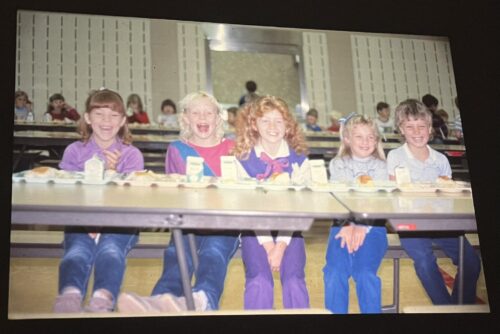
This picture was taken in 2nd grade by one of my most beloved teachers, Mrs. Noble.
Growing up, this phenomena happened again and again. Friends would often come and go, and it made it very difficult for me to trust that others truly wanted to be my friend. The worst friends were the ones that once they found out that I was not Mormon would state that it did not matter, but would eventually leave when I would not convert to their faith and/or when it affected their social status and ranking within their community. In saying that, I was very lucky to have one incredible best friend named Nancy, who was Mormon and loved me inside and out. We were inseparable. In fact, we did everything together. When I met her in elementary school, we instantly knew that we would be best friends given our great love for unicorns. Our wild untamed imagination would take us on grand adventures into the forests and rivers we spent hours in day after day for years to come.
Our friendship saw us through many trials of childhood and adolescence. I will never forget the day that I decided to wear a small crystal cross to school that was inspired by my idol Madonna. That chilly fall morning, I carefully put on my new necklace and headed to school. It was then I learned that Mormons do not wear crosses AND that when I wore it, I basically outed myself by not being Mormon. Not only did people scowl at me, but others confronted me and asked if I supported the death of Jesus Christ. I had no idea what I had initiated as I quickly worked to hide the pendant, the damage had been done. People withdrew and avoided me and it was soon that I found myself at odds with my best friend over my fashion choice. In being hurt many times before, I expected her to leave. She was was angry I chose to wear the cross. Despite my explanation of what inspired me to wear it, we fought. She challenged me to ask myself if wearing that was more important than our friendship and her wishes to respect her desires for me not to wear it. In flipping the script, I inquired how an object could all of a sudden mean more than me and our friendship. It was deeply confusing and although we sought to let it go and make up, that altercation was significant and planted the seed for other things to come.
Nancy and I drifted apart in high school. As the social pressures continued to mount as we grew older, I grew tired of the same conversations and outcomes. A good portion of my school years was all about staying invisible and trying my best to not be bullied more than I was. It often came up with many I knew around why I would not convert.
“Wouldn’t it just be easier if you became Mormon,” they would ask.
“No,” I would reply.
From there, it would drift into trying to justify myself, my choices and defend my experiences. I often found it to be a waste of breath, as it honestly was not about me. It was about another ethos that had many other conditions and variables that were expected to be upheld and adhered to. Given that I was not raised in the church, I often brushed shoulders with these ideals and beliefs that were not always obvious or spoken.
One example of this is one of my dad’s favorite coming of age stories. I remember being around the age of 12. It was at this time, that a distinct rift rippled throughout the neighborhood network as we got closer to summer break. The girls I knew on the road flipped seemingly over night. In getting onto the bus, the smiles and nods I once enjoyed turned to avoidance and cold shoulders. Only one friend who lived on the road remained consistently kind to me. (Thank you, Tamara.) I had no idea what had happened. With a few weeks to go before school let out, they all changed their tune again. Instead of being cold, they became extra friendly. Each made an effort to talk to me and then began inviting me to a church summer camp that would be taking place for few days at Bear Lake. As the days passed, the pressure mounted, as they insisted I join. I shared the out of the ordinary interactions I was having with my parents. My mother lit up with joy and encouraged me to consider going. My dad, however, cautioned me not to go. Unlike my mother who was enamored with how nice the neighborhood girls were treating me, he invited me to look closer at their behavior and asked me to inquire what was driving the changes.
Both my parents cared and did their best to make their case knowing full well that the other was on the opposite side. My mother shared her desires for me and my sister to belong and fit in. In expressing her wishes, it was the first time that she had opened up to share her experiences of growing up in Utah as a Jack Mormon (a person who claimed to be Mormon but did not do what strict Mormons practice). She had joined the church for support. Given the challenges that she faced growing up within her family, she went for support only to find that many turned their back on her out of judgement of her parent’s choices. After hearing her experience, I was not so convinced that going to camp would be a good idea.
My dad, on the other hand, stuck to logic. In building on my mom’s account and everything he had observed and experienced first hand, he dug in and asked deeper questions. I think it is important to share here that my dad moved to Utah from New Jersey. He was not college bound, but given that the draft was happening, he decided it was best to apply to several schools. He decided to go to Utah State University and made the move. As an outsider, he had no knowledge of the Mormon religion. He, and many other non-natives and international students, quickly figured out that they were the minority and hunkered down to complete their term. My dad had shared many of his “outsider” experiences and given that he was not driven by being popular and even took pride of being an outcast, he always had a unique and different perspective to share. In hearing what was going on at school, he expressed his worry that I again would be hurt and disappointed. He asked me to really consider what my motives for going and what theirs were for having me attend. In the end, I decided to go. A big part of me was hoping that things would change, however, I prepared for the worst.
When I told the girls I was going, they were elated. They jumped up and down and exclaimed how much fun we would all have together. The enthusiasm then turned to details. In addition to signing a release form, it was expected that each of us would attend a series of classes to prepare for what to bring as well as what to anticipate during the excursion.
I arrived at the first class. The girls were excited to see me. My heart was relieved. As they welcomed me, we all sat down and waited for the instruction to take place. I noted where everyone sat. There was a clear camaraderie. The groups and cliques I saw on the bus and at school were present in that room. However, this time, I was invited to sit by a few of the more outgoing and boisterous girls that were more popular. When class ended, everyone departed. I was slightly stunned how many did not say good bye to me but acknowledged others. I simply chalked it up to group dynamics.
The next I went to was different. This time, I was not greeted as I had been the first time. Cordial hellos were given and then when I went to take my seat where I sat last time, I was encouraged to sit somewhere else. I sat near Tamara.
The day that we all gathered to take off, my mother bustled all around making sure I had everything I needed. I was dropped off at the church parking lot where several large vans waited for us. We were assigned to different vans and as we took our seats, I felt myself disappearing and becoming invisible. I sat quietly and watched as each of the girls got settled in with their friends and shared their excitement for the trip. When we arrived, everyone gathered and listened for next steps.
Now, I honestly do not remember much about what we did. What I do recall was a strange game we played where the older girls asked the younger girls one-by-one to go under a blanket while everyone else sat in a circle around their target. (The younger girls who had not played were asked to sit outside of the tent waiting for their turn.) We were given a description that we were in a hot desert and that we needed to take something off to so we could be cooler. As girls disrobed each item piece by piece, the younger girls were told to place it outside of the blanket. Thankfully for me and several others, we were tipped off to just take off the blanket and not play their silly game. (My reputation was already tainted and I honestly did not need humiliation added to the list.)
Beyond that, I recall being ushered away and “invited” to go hang out with someone else. As I made my way over to another girl or group, the same thing would happen. It was not long before I found myself choosing to be alone and avoiding participating in activities. It was a space and place I knew all too well. I could not help but think about how my dad was right. The only reason that I was there was that I was a person of interest to convert. No one wanted to be my friend. Hell, no one even wanted to be around me or even noticed I was gone. So, I sat and waited for the whole experience to end so I could go back home.
The last night that we were there, all of us were rounded up to gather around a campfire. The older women and girls of the camp invited each person to “bear their testimony.” I had no idea what this process entailed. However, I quickly figured it out as each person took their turn emotionally declaring their love for the church and how being a LDS had made them a better person. One by one, they burst into tears and got very emotional about how their lives had changed by being on the path. The more I listened, the more I grew upset.
When the last girl shared her testimony, everyone immediately started to get up to leave. It was then that one of the older women asked me if I would like to share anything. Everyone’s heads turned my way. I realized that this was my moment to share my “truth” and if I was going to go for it, I might as well go all in. So, I drew in a deep breath and stated that I would like to share my experience.
The years of pent up frustration and rage funneled into my throat as the words began to form. My stomach churned with anxiety.
“Many of you asked me to come on this camping trip saying you wanted to spend time with me. You begged me to come and told me that I would have a good time. I took a chance and believed you. Since being here, I have been ignored and excluded. The times that I have tried to be involved, I have been told to leave and go over to another person or group. You didn’t even notice when I stopped doing activities…”
As the words poured out, I watched as everyone’s demeanor instantly changed to shock and dismay. I didn’t stop…
“After listening to you all speak about how the church has made you a better person and experiencing what I have this weekend, what I can say is that your words and actions don’t match. Given what I have gone through here, I can tell you that I would never join the church. I was hopeful that something would change and that you actually cared about me, but you don’t. All I know is that I don’t want to be a part of something like this and I honestly cannot wait to go home.”
The silence was deafening and as their stunned faces stared back at me, a couple of the girls burst into tears as the guilt and shame began to take over. Soon others joined. In an effort to contain what wildfire I had just ignited, the older girls and women immediately apologized and said that they were sorry for what I had felt and endured, but that this is not what the church had taught. One by one, the girls came forward and expressed their remorse by following the lead of what the older women and girls did. For a moment, I felt seen and heard. As they hugged me and assured me that things would be different, I hoped that would be the case. Yet, when I woke the next morning, things immediately fell back into the same pattern. As we took our seats in the van, I could feel a coldness towards me that I had never felt. Whatever I had stirred up certainly created more tension for us all.
When I got home, my mom was anxiously awaiting an update. When I shared what happened, she was horrified, and not for the reasons maybe one should have been. My “truth” wasn’t exactly welcomed. In fact, all she could exclaim was what were the neighbors going to think. Her mind darted off to a myriad of other potential issues that this kind of PR disaster was going to cause for our family. In seeing her disappointment, I went outside to talk to my dad.
When I found him, he was crouched down weeding along the edge of a flower bed near one of our ponds. His cigarette was pursed in the corner of his mouth. As he shook the soil off of one of the weeds he had unearthed, he asked, “so, how did it go?”
I told him everything. I shared how at first the girls were nice and then how it got worse and worse. He did not make eye contact with me. Instead, he focused on the task and at hand and listened. I kept going. When I got to the part about testimony night, I told him what the other girls and women shared and how I felt frustrated. Then I told him I was invited to share my experience. My dad looked up at me and asked what happened. I told him everything I said. His eyes lit up. Removing his cigarette from his mouth, he sat back and put down his weeder and asked me, “did you really do that?”
Expecting to be admonished, I quietly said, “yes…”
He then acknowledged my courage and boldness and told me how proud he was of me speaking up to share what probably no one had heard before. He smiled and then put a hand on my shoulder as an act of admiration. I was really surprised! A huge wave of relief fell over me.
Dinner that night was contentious. It vacillated between pride and shame. Being in the middle I experienced the tug and pull in many different directions that spanned over various topics and fears. For a 12 year old girl, I did not exactly understand the nature or gravity of what had been unleashed. My sister and I both watched as my parents debated the implications of what speaking my truth may bring our way. My mother feared it would make things harder on us. Everything revolved around “social currency.” In other words, opportunities were governed by who you knew.
It was no secret that we had to work extra hard to show that we were good people. It often was met with being highly conscientious about what we wore, how we spoke, what we talked about and nodding where it was expected we nod. My parents were adamant about me and my sister being very mindful about blending in enough and not drawing attention to issues and areas that would cause problems. Given that they both smoked, we already had lost a lot of social points as people did not welcome my sister and I sitting with them on the bus. Later, this would prove to be a problem in middle school, as I was suspected of drugs and had my locker searched multiple times by the administration.
The whole church camp experience provided me a chance to see what truth could ignite. It was something that I always kept in the back of my mind. Given that it was liberating, it was also not exactly welcomed. In saying that, I truly longed for a space and place where I could by myself. This desire took me into new and uncharted territory.
******
Early on, I had made up my mind that I was bound and determined to leave Utah as soon as I could. I focused on my studies and worked hard to get into honors classes. This benefited me in many ways, as class sizes included 30+ students per room. This would often leave me without a text book and sometimes a desk given that my last name was at the end of the alphabet. I found honors classes to be smaller and less disruptive. Going through one middle school was challenging, but again with Utah’s large families, my fellow Gen Xers and I had two to go through. The first one at Spring Creek was not that bad, but when we transitioned to South Cache (affectionately known as South Trash), things dramatically changed. This out of date building had no air conditioning as was parked near a slaughter house. As the spring days transitioned into hot ones, the blood pools outside would begin to discharge a terrible wrench that left everyone feeling nauseous when the valley winds would change.
It is a well known fact that most middle school experiences are not so pleasant. Kids can be incredibly cruel while they are trying to navigate a more sophisticated social ecosystem while dealing with hormones. The 8th and 9th grades at South Cache introduced me to a whole other different echelon of mean girls. There was one particular girl that me and my friends, along with many others, feared being a target of. Gina was a popular girl that had a commanding presence and forked tongue. She had way of dividing people with her words and her countenance. She and her posse often took joy in demeaning others by exploiting their vulnerabilities, looks and where one ranked in social and economic status. She had a financial advantage over many other kids in that her family could afford very nice and expensive clothing and items for her. Dressed in the latest fashion of Z Cavaricci, Guess and Girbaud, she would wait for her friends to arrive at the top of the first tier of stairs and then motion her squad to patrol the halls to find her next target(s) to terrorize before class would start. It would not end there.
My worst interactions with her were in a Mrs. Culvertson’s math class. I was not good at math and had to work extra hard at getting good grades. This often entailed many painful homework sessions with my father that would occasionally involve him throwing a book at the wall given his sheer frustration with my inability to comprehend the material. The correct answers took hours to obtain. I dreaded going to math class. Mrs. Culvertson had decided it would be a fantastic idea to arrange desks in groups of four. Here, one A student, B student, C student and D/F student would be placed together with the expectation of helping each other learn concepts and equations. Gina was in my quadrant. As the A student, she knew I had the answers and she and her best friend Cassie, who also sat in this configuration, made it their business to make sure that I shared what I had so they could cruise on through. The other student was a girl named Shayna. She was kind and sweet person, but given that she was overweight, it instantly made her a target. I felt bad, as she would often get the brunt of their attention. However, it did not absolve me from their wrath. When I refused to give my precious answers that I had worked so hard for, Gina turned up the notch and played dirty to get what she wanted. She stole my math book and terrible things about how I was going to hell in it and explained that matters would only get worse if I didn’t comply. I did my best to stand my ground. I told my parents and brought my concerns to my teacher that I could not learn given what was happening. I requested being reseated. Nothing changed and in fact it only got worse as even my own teacher gave into the antics in an effort to appease Gina.
In the end, I gave in. She exploited that I was not Mormon and before class would start, she would focus everyone’s attention on me by asking what I did over the weekend and if I went to church. From there, she did not hold back by insulting me and my family by asking what was wrong with us and why we would want to go to hell. Others would laugh and follow suit. The only way to stop her was to pass over my hours worth of work so that she would leave me alone.
She was one of my worst bullies and to be honest, she was many other of my fellow students worst nightmares too. It wasn’t until in honors biology class that I lost it and served up a sarcastic response to one of her catty comments that the whole energy in the class shifted. The laughter that filled the room instantly silenced her. I had found her weak spot. Placing attention on her using humor and laughter changed everything. I wasn’t the only one who witnessed her shrink, and soon others followed suit in leveraging what new knowledge they had gained.
The years of my parents telling me to be quiet and kind when being confronted with a bully ended. Turning the other cheek and accepting disrespect again and again only to not bring additional attention to myself or my family had taken a toll on my nervous system, self esteem and even desire to live. I was furious to find out that there were other ways of solving the bullying problems I had been dealing with for years. Being nice comes with a cost. In confronting my mother about why she and my dad did not help prepare me with other skills and tools that could have alleviated years of suffering, she replied that she herself did not want to raise a bully and for me to know kindness. That was not the answer I was looking for, but given where I am at now, I can honestly say I understand what she means.
Gina and her posse lost power and influence when we all transitioned into high school at Mountain Crest. In a sea of other older kids, we had new challenges to deal with. Changing schools was a big opportunity to change your position in the social strata. Here, you could enter into a new ethos by becoming someone new by wearing new clothes, choosing new friends and also selecting new interests and pastimes. There were many options. I had longed to find friends who knew what it was like to be in my position. It was exhausting having to defend your position or explain things to others as to why you were not LDS. The truth was, I only knew of one other family that was not religious like mine and had parents that had moved to Utah. They were my parent’s college friends and although we spent time with their kids growing up, I did not exactly feel close to them. We had a shared understanding of what it was like to be in the position we were in, but we also had very different priorities. Unlike other people who had the support and connection from other religions, my family and I had spaces and places we could go to seek selective support. We stayed away from politics and religious discussions entirely. Given what I had experienced first hand with religion, I honestly had no desire to have anything to do with it.
I chose to befriend many outcasts and foreign exchange students while in high school. I enjoyed getting to know the international students. Many were grateful I reached out and could appreciate and accept them for who they were. Most were overwhelmed by the culture shock and struggled to adapt. For those who elected to stay, I did my best to provide support. My first love was an exchange student from Spain. Alvaro and I were inseparable. When he left, I felt lost and a deep sense of abandonment hit hard. It was another layer of hurt that made it difficult to connect to others. In returning my focus to graduating high school and leaving the state, I did my best to mindfully choose friends and relationships that did not tie me down or hold me back. Most of my friends were guys. I found them to be less inclined to be drawn into drama and the ones I hung out with were not exactly focused on talking constantly about missions and marriage.
My closest guy friends were Doug, Bob and Brion. Doug was the son of a bishop. Being the youngest of I can’t remember how many, he was the last to leave the house. I was honestly surprised that his family would allow for us to even be friends. However, they came to accept me and were nice when I would come over. The rule was that the door could never be closed to his bedroom, which we respectfully honored. Doug loved rock climbing. So, we would often head out to the canyons to go with our friends. Bob was a self conscious guy who was quiet and often yawned a lot. He lived with his aunt Cindy and cousins. His mom was not mentally well and had entrusted her sister with him as she stayed to get help in Texas. Bob struggled to fit in and given that we were outcasts, we made an effort to go out of our way to involve him in whatever we were doing. Brion moved to Utah when he was 15. His parents converted into the LDS religion and decided to move to the mother land from Portland, Oregon. He and his siblings relocated with great protest, and plans to move and return back immediately ensued.
We spent an enormous amount of time together. From camping, rock climbing, skipping (or sluffing) school, to playing pranks on others, we always had creative ways to pass the time. It was not until much later I would see how each us (including two other friends, Dave and Micah) played a very significant role in each other’s lives. We provided a life line to one another in ways that most others could not ever hold.
The culture in Utah is one that polarizes. There is no middle ground. Now, although this is changing, my experience growing up was one where there was Mormons and Non Mormons. The non LDS group included Jack Mormons, excommunicated individuals, people from other faiths, people like me and anyone else who was considered to be a non conformist. This proved to be very problematic. In having such extremes, it often caused people to adopt very rigid beliefs and identities to protect and preserve their position and standing. Those who were religious were expected to abide and uphold the tenets of their religion in a perfect and infallible way. Their actions were measured and evaluated through the lens of their peers and elders. Under surveillance and the eyes of the Church, going against the grain or falling out of line was quickly acted on. It made being authentic and human at times very challenging as space to discover who you are was limiting. On the other side, those who were regarded as unsavory, lost, on a path to hell, etc. were ones that often resigned themselves to being unworthy, unlovable and broken. They also included those that were bitter and fought against the mainstream culture as an act of rebellion as well as self preservation. Many who took drugs to protest the mainstream way quickly fell into deeper and into bigger drug addiction. The lack of middle ground to explore and challenge your identity while creating another one as a younger person was extremely thin and there were endless people around to quickly categorize and throw you into a box with a permeant label that would follow one there onward.
In hanging out with the outcasts, I did my best to walk the middle ground and not get lost in the culture war that ensued each and every day. I would often ask my dad what life was like outside of Utah. Between him and Brion, I had my eyes set on something other than the asphyxiating environment I was living in.
In being mindful of not going off the deep end, it was still well known who I was hanging out with. Our group of friends had all sorts of people. We would often date one another for a while and then something would happen where we would move onto the next prospect. In one such event, I ended up dating a guy for a week named Brock. Brock was an outgoing person who had a love for theater. During the time that we were together, he decided to publicly come out of the closet and share he was gay. He felt safe enough to tell me at the time he was dating me and I encouraged him to be who he was. When the news was shared, he was bullied terribly. Awful things happened to him and many of us were deeply concerned for his personal safety and well-being. Both sides of the culture were not exactly accepting of his “choice.” I will never forget when his mother called my mother to yell at her. During that brief phone call, I distinctly remember his mother accusing me of turning him gay. She blamed my mother for how she raised me and contributing to the conditions for ever allowing for this to happen. Brock was also the son of bishop and I can only imagine what the implications were for him, their family and having to navigate this with the church. My mother and I were a convenient scapegoat. As she hung up the phone in her in rage, I laughed and said I never knew that I had that kind of superpower. What his mother did not know was that I spent a lot of my time trying to keep him from falling into the depths of the counter culture. After he came out, things changed dramatically and we grew apart as he fell into the divide.
I honestly could not wait to graduate and move on. As I continued to enroll into Advanced Placement (A.P.) classes, I kept my grades up to move on. While others were talking about missions and marriage, I went to work at the old folks home, Sunshine Terrace, and saved what little money I could to make my escape and to go out to concerts (or gigs as we called them). Here, I had a chance to broaden my social scene and friend base. I met other students from neighboring high schools. I was excited to have some girlfriends who were more like me and strived to walk the middle ground while also expressing their own unique style. Sonia and Shelley were from Logan and were close friends. We loved going to the concerts and visiting friends around the valley and beyond. I became particularly close with Shelley. We had a great deal in common and also worked at the Sunshine Shithole together. She was a year older and we both had our eyes set on going into medical school. We often would hit the goth/industrial dance club in Salt Lake and get ourselves into trouble meeting guys and drinking peach schnapps. We had a strong bond as we both felt the pressures to conform yet kept our edge in maintaining our own individuality.
I remember one evening Shelley was not available. In working with another gal named Becky, I was asked to come to a stake dance (an LDS gathering) at Utah State University. Becky pleaded with me to go as she did not want to attend, but had agreed to go with some of her other friends. Reluctantly, I accepted and said I would be her wingwoman and help create an excuse to leave early so that we could do something more exciting. Given that I was not interested in attending this event and knew it was for singles to meet one another, I planned ahead and grabbed a cross pendant and put it on my necklace. Thanks to my earlier experience in middle school, I knew the power of what a cross could do and I certainly planned to use it to my advantage. I tucked it beneath my shirt and left to meet her.
The space was full of young college kids. As we made our way into the large hall, Becky instructed me to stay behind.
“I am just going to go and say hi to my friends and let them know I made it and then I will come and find you.”
She left and and I stood there wondering what to do. It was then that a guy with longer brown hair came up to me and asked me if I wanted to dance. Surprised, I said yes. So, I joined him. As he busted out his best moves in an effort to impress me, he asked me the one question that every Mormon initiates a conversation with.
“Are you LDS?”
I replied, “no.”
He then asked, “do you have any interest in becoming LDS?”
I said, “no.”
He then asked what my name was and followed up with what my major was. I replied that I was in pre-med. It was then he stopped dancing and immediately left the dance floor. I was rather stunned by his immediate and abrupt departure. Standing there, I began to look around and feel a whole other level of discomfort. I pulled out my cross and bared it for all to see. I wanted to leave.
Over the year, I have replayed that scene in my mind over and over again and imagined what exactly it was that made him leave. Was it that he did not want to waste his time, or was he intimidated that I wanted to go after a profession that made him insecure? I never got my answer, even after I ran into him at Hastings (a local music, video and bookstore). I was shocked he remembered me and even said hello. When I inquired as to why he left, he conveniently said he did not remember doing that. It was not much after that I walked out of the store to return the same coldness and disregard he had given me.
As I continued to expand my spaces of meeting people, I met a guy named Josh. He had returned from his mission from Brazil. He was a friend of someone I worked with. Josh took an immediate interest in me. I made it very clear that I was not LDS and had no interest in converting. He stated that was fine, but several weeks into our dating experience, he grew very sad. I could tell something was on his mind and I offered to pick him up and take him out to a movie. He reluctantly accepted. As we drove into town, he asked if we could talk. I took him to Merlin Olsen Park, a place that me and my friends spent a lot of time at over the years looking for paranormal experiences and playing games in the dark. It was also my contemplation place. As we drove up, he asked if we could walk over to a bridge that spanned the Logan River. Standing there, he longingly looked up at the LDS Temple and then looked back at me. It was then I knew I was going to get “the talk.”
He shared he was very confused. He explained that he cared deeply for me and that he was really struggling to understand how I could be as good natured as I was. When I asked him to clarify what he meant, he said the following.
“I just don’t understand how you have morals, ethics and values and that you are not Mormon.”
My heart sank, not just for the fact that this was the end of our relationship, but that this was what he had been taught. All I could think about was the many pictures he shared with me on his mission of those he converted and how one family, who refused to covert, became his favorite family and memory of his experience who he loved and adored. How could he not see that they had guiding principles like me and so many others across the world? My heart broke for him. It broke for many of the Mormons I knew. The cognizant dissonance we had between us was too great of a gap and there was nothing I could do but step back and encourage him to go. We both felt so sad, but for many different reasons. About a month later, I received an invitation to his wedding reception. As the bigger person, I went with my friend who introduced us to wish him and his wife well. It was the last time I saw him.
During my senior year, I contracted mono. For nearly a month I was unable to go to school or work as I did not have the energy or stamina to do much of anything but sleep. I fell behind in my studies and soon was confronted with the reality that all of the college A.P. courses I was pursuing would not be credited given my absence. I decided there was no reason to continue on with my senior year and that I wanted to graduate early and start college as soon as I could. In asking what was left to complete, I had an art class and a life skills class to take for my final credits. I was really angry at this set back. Having little to no motivation to do my best, my focused shifted to doing as little as possible.
Brion and I ended up in life skills class together. Part of the assignment was to learn basic skills to prepare you for big things like marriage, paying the bills and dealing with unexpected life events that impact your ability to earn money and deal with a surprise kid or two. We were asked to partner up. Instead of taking one husband, I elected for two. Brion and a kid from Denmark became my husbands, which I found humorous and fitting given the polygamous history of Utah. As I took the lead in my household, we crushed it in managing bills and finances. We learned about sexual harassment and the difference between love and lust. When it came to reading assigned books, my role of being the top A student and writing papers for Brion immediately flipped. Having no desired to read the assigned book, I turned to cheating and getting the answers him. When we got caught, our teacher immediately believed me due to my academic standing. Brion, however, took the brunt and got in trouble. I had never in my life been so cavalier about everything. I just did not care any more, and like him, I longed to leave.
______
 Sitting in Maurice Wiberg’s art class, I found myself getting lost in painting a barren white tree against a cobalt and navy blue background. As the layers of paint made their way onto the canvas, I drifted off into the imaginal realm of other potential realities. As much as I was unhappy about losing all my A.P. college credits, I was grateful to be free from the pressure to excel and perform.
Maurice was one of those rare teachers you only meet once. His uncanny ability to see and connect with his students created a safe and sacred space where one’s inner world could be seen and witnessed with deep care and regard. Here, you were a person—able to exist beyond a label, clique, or your own internalized story. He made space for curiosity and possibility by asking questions about what was being crafted and how emotion played a role in the experience.
Just as we would get lost in our work, he would too. I remember him ripping off a giant piece of butcher paper and taping it to the wall. When asked what he was going to draw, he replied that he didn’t know and reached for his charcoal set. Over the next day or so, a giant psychedelic mushroom appeared, and within its dreamlike tendrils you could feel it pulling you into another otherworldly dimension. The techniques he taught us came alive, and we marveled at what poured out of him—even when it made some uncomfortable.
When he finished, many students asked if they could have it. He thought long and hard and, in the end, decided to gift it to me. Later, when I asked him why, he replied that I would respect what he had created. Deep down, I understood what he meant. In the days before cell phones and digital cameras, art like that could have been grounds for disciplinary action and parental outrage. His choices were always calculated, and when he made mistakes, he talked openly about them, sharing what he learned—including what he had learned from his psychedelic mushroom trips.
He fostered a culture of respect that was lived rather than preached. From that, trust evolved. It was even extended to those he deemed worthy of breaking the school rule against leaving campus—students allowed, from time to time, to drive into town and bring back donuts for the class on Fridays. I was one of them. The only caveat was that we returned with donuts and time to spare so everyone could enjoy one.
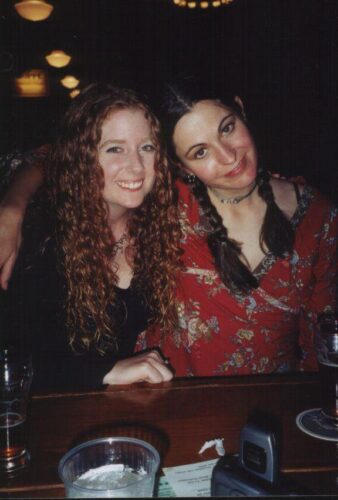
Me and Shelley off on one of our many rebellious adventures.
As my winter quarter neared completion, I turned my attention to enrolling at Utah State University. Shelley and I began making plans for the classes we would take together. We were both interested in pre-med, so we researched which courses would move us in that direction. Both of our fathers worked at the university, which meant we got a sweet deal on tuition. I didn’t exactly want to go there, but given the circumstances—and a few other reasons to stay—I agreed to give USU one year.
I was looking forward to a change in scenery. While many of my friends stayed behind to finish high school, I started my first full term with an intense schedule: economics, human anatomy, Spanish, English, and a dreaded remedial math class. I commuted to campus and worked part-time to cover gas and going out. What little extra I had, I saved so I could someday leave.
As an A student, I expected a lot of myself. The classes were difficult—especially human anatomy with Andy Anderson. He prided himself on his attrition rates. Each week, he announced what percentage of students would drop to spare themselves a poor grade, followed by statistics for those who chose to stay. In the end, he made a compelling case for leaving and taking a class where the return on one’s investment—learning something of value—was higher than feeding another person’s ego.
I did manage to complete my other challenging class, economics. It was difficult in a different way, and what I learned there was sobering. I wasn’t the only one who struggled, especially when math crept into the material. Falling behind, I decided to attend office hours. Although I don’t remember his name, I recall that he was a man in his forties who always seemed on edge and had a chip on his shoulder.
Twice, when I sought his help, he was nowhere to be found. The one time I did catch him, he was visibly irritated by my presence. I got straight to the point and asked if he would help me.
He said, “Not sure what good it’s going to do. It seems like a waste of everyone’s time if your only goal is to get married.”
His words struck me. As much as I wanted to defend myself, I stayed quiet and tried to imagine the world from his perspective. From that point on, I saw campus differently. His point was valid. In many classes, attention drifted to subjects other than those being taught. With young men returning from missions in search of a forever wife, it was well known that many women attended school for the so-called MRS degree.
This dynamic was especially evident in my Spanish classes. I had taken several years of Spanish in high school and continued with consecutive courses at USU, yet every quarter we started behind. The collective attention span simply wasn’t there. Frustrated, my desire to leave the state and attend school elsewhere grew stronger. I focused more intently on saving money and took on temporary work to stash extra cash.
In addition to working at Sunshine Terrace, I signed up with a local temp agency. Most assignments were at a company called IKON, where I helped assemble treadmills and other exercise equipment on an assembly line. The work wasn’t hard, and I quickly learned that a little flirting often led to longer and better assignments.
During one shift, I met a lead named Mike. He noticed me immediately and asked if I went to USU. When I said yes, he asked if we could meet for lunch. We agreed to meet at the Hub on campus. Mike was a good looking guy and was in hid is mid twenties. When we met, he bought pizza and suggested we go for a drive to talk.
I hesitated and told him I had a test during my next class. He promised we’d be back in time. Reluctantly, I followed him to the parking garage and climbed into his truck, which was jacked up to Jesus. I placed my backpack between us. We drove off into the snowy roads of Logan Canyon. It was March, and the snow was beginning to melt.
I knew this canyon well. Friends and I often climbed and hiked there, sometimes visiting the Nunnery—a notoriously haunted former Catholic site where stories of drowned babies and other supernatural encounters circulated as we trespassed in search of our own experiences.
Mike played country music, which I despised. Watching the time, I reminded him of his promise to return me to campus. “Just a little further” and “almost there” eventually brought us to the moment he turned onto unimproved road to Right Hand Fork. I realized I was in serious trouble. He stopped, got out, switched the hubs into four-wheel drive, and continued climbing up into the the remoteness wildness of the mountains. My mind raced.
He asked if I wanted to listen to something else. Flipping through his CDs, the only disc I recognized was a Tori Amos single, Crucify. As her voice filled the cab, I calculated my options. At 105 pounds, I didn’t have much physical leverage. I studied the snow and knew it would be a long and exhausting hike back to the main road. Intuitively, I knew I would have to get creative if I was going to get out of this unharmed.
The truck stopped. He turned off the engine, locked eyes with me, threw my bag behind the seat, and unbuckled my seatbelt. Effortlessly, he pulled me up against him and said, “Let’s pretend like we know each other really well…”
I thought to myself, This is not Mr. Rogers’ fucking neighborhood, and knew I had to act fast. He began pressing himself up against me and asked me to touch him. Gently caressing him to buy time, I slipped into my mind and recognized that one thing I had was my intelligence and wit. So the mind games began.
“Before we go any further,” I said, “I need to ask you something.”
As his eyes met mine with passionate intensity, a devilish smile spread across his face. He asked what I desired to know.
“Are you Mormon?”
The question instantly shifted the energy and I went for it. I explained how I was not Mormon and that everything I knew about the church was that sex was very sacred and was supposed to be reserved for marriage. Without hesitation, I continued by questioning his sexual history and how he dealt with this conflict given what the church expected if he was Mormon.
His whole demeanor changed and he grew angry and outraged that I would dare challenge him, his faith and his choices. In seeing how he was emotionally charged, I leveraged the energy to my advantage.
“I mean, just think, if you sleep with me, what is your future wife going to think and say? Won’t this affect your relationship? How are you going to explain this to her? Won’t this affect your relationship with God and the afterlife?”
The interrogation led to disgust. As he reached for the keys, I knew I had managed to successfully destroy the mood. However, I was not out of the woods yet. As he turned over the engine and threw the truck into gear, I braced myself for what was to come next.
“I’m a good person. You’re not. You’re dirty. You’re a whore. You’re going to hell—and if you had any sense, you’d convert.”
At the age of 18, he didn’t know I was a virgin. As he projected his shame, I softened my voice and shifted my strategy to ensure my safe return. I asked him about his faith and listened attentively. We finally made it back to campus two and a half hours later past the time he promised to have me back.
I didn’t return to that job for a week. When I finally did, I asked where Mike was. No one who worked the line knew of a “Mike” and I never saw him again.
———-
In 1996, I moved to Portland, Oregon. Inspired by my friend, Brion and his brother, Erik, who had grown up there, I relocated with my boyfriend, Dave who later who would become my first husband. Having no car or jobs, we brought what cash we had and started a new life together. We both landed jobs at PetSmart and took the bus to work. Upon establishing residency, we then resumed with school and graduated from Portland State University in 2000.
I often think back to my dad’s stories of what life would be like in another place. He was right. It was different. No one gave a shit about whether I was Mormon or not, and that honestly proved to be a really big challenge for me. It took me years to come to realize how I had constructed my identity around one question, ‘are you LDS?’ Depending on my response, I could play along and pass to make things easy if I knew I was not going to see people again, or carefully map out next steps after revealing my status. Moving to Portland was difficult in the sense that I had lost my whole identity and that brought bigger challenges of finding out who I was that was equally, if not more comfortable, than operating within the constraints that I had been.
When people would ask where I was originally from, I began to dread telling them as they instantly associated Utah with polygamy. Initially I spent a great deal of time trying to educate friends, co-workers and other acquaintances about what Utah is actually like. Most of the time, my accounts were not as fulfilling as the ideas that media portrayed. So, I eventually stopped sharing that I was from there. I did not feel that I could be seen or heard —- honestly anywhere —— and that is where the deep work began.
It took me years to realize that what I was dealing with was an identity built around victimhood. I had been oppressed. I had been victimized. However, what I lacked was an understanding of who I could be beyond that. During my college years, I took many classes in minority studies. (I practically did a minor in Black Studies.) Although my experience was different, learning from what others had to endure and navigate did not make me feel so alone. We had a shared experience and I was able to understand what oppression does on a whole other level as well as how it is baked into our consciousness through the thoughts we think, the words we say and the decisions we make on a daily basis. In being able to partially process what happened through another lens and framework, I was better able to understand what it does to the human psyche as well as how and why it can be soul crushing at the same time.
During the first several years I lived in Portland, I would return to Utah a couple of times a year. The differences were striking. Sometimes I would make an effort to see my old friends. However, as it is the case most often, we had grown a part and were on separate paths with our partners, families and careers. I visited less and less and moved on with my own life. Dave and I climbed the corporate ladder and grew weary of the life we were sold. So, we up and moved to central Oregon where we bought a town and lost it and our marriage in 2009 with the economic downturn. I was not the only one who was was starting over. My parents ended their 34 years of marriage and were doing their best to navigate life being single. As with any ending, new beginnings happen, and returning to Portland I found love.
Aaron and I met through a common friend. He was unlike any other person I had ever met and his big heart and mind took me into terrains and spaces I had never visited. When I shared what my experience was like growing up in Utah, he listened. His only experience with Mormons involved a girl he briefly dated in high school. Growing up with a Catholic influence, he had branched off to study many different religions and spiritual traditions at a young age. Like me, he had no interest in organized religion yet appreciated finding ones own spiritual experience through learning and introspection.
The first time that I brought him to Utah was to accompany after my grandfather died. I technically was still married to Dave and knowing that I was going to be encountering my family, I expected judgement and criticism. When we arrived, he remarked on how everything seemed nice and normal. I enjoyed taking him to places that my friends and I would haunt. In pulling back the veil of the Zion Curtain, I would show him the little things that pointed to the Utah culture and how it inserted itself into spaces and places in various ways. From the seminary buildings that were strategically placed next to the public schools, the liquor laws that at the time required private clubs to be established to serve hard alcohol, to the counter culture influence. I remember bringing him to Macy’s, a LDS owned grocery store. As we walked around the store, I pointed out the other tell tells that were typically not found in grocery stores we shopped at in Portland. From large bulk sections where garbage bags of popcorn could be found along with an aisle of survival food and storage supplies, along with the LDS card section reserved for those going and returning from missions, he started to see what I was taking about. He noticed the large families, and the type of food that was being purchased. The next thing we did was make our way down the beer aisle. I asked him to notice what would happen when we made a selection and purchased it. As we picked up a six pack, we watched the glances other patrons gave as we made our way up the register. As expected during the check out process, we were stared down. When asked for our ID’s, the cashier changed their tone when they noticed we were out of town. The demeanor shifted to a cheerful tone and the questions flew about what brought us here and drifted off to some random relative that lived up in the area. As we left, he could see what I was talking about.
In bracing myself for the funeral, we traveled down to Salt Lake. Here, we would be meeting with members of my family that I had not seen for a very long time. My mother was the middle child and most neutral when it came to religion. My uncle and his family were not Mormon and fell on the more extreme side of the pendulum when it came to the counter culture. My aunt was super Mormon. With the typical large family, she had worked with her local ward to arrange for an after service reception.
Thankfully, my family was kind to me and Aaron. When we made our way to the church for a very late lunch, I warned Aaron about the food. Given that this man eats everything, he learned what I meant. Making our way into the gymnasium, tables of food were set up that included crockpots of various dishes, wilted lettuce salads, somewhat dried out vegetables and a ton of baked items (sugar being the guilty pleasure of many). Making our way up to see what was in the crock pot, we noticed a pressed ham that was soaking in 7UP. It had turned black. Horrified, he looked at me. Sticking with the baked goods, I got a few items to tie me over until we could get something else. He, however, loaded his plate on funeral potatoes, chili and some other items and sat down. After a few bites, he declared he could not eat any more. There was no flavor. I smiled and nodded. Spices were often not used in dishes given that younger kids do not like them. Keeping things bland was a way of making the most of meals.
Our trips to Utah over the years and eventually with our son, Daniel, were always filled with adventures. We made an effort to see Shelley and her family. Time there flew by and when we left, we all would feel the heavy energy shift when we hit the Idaho border. Things made a very big turn in our family when Ruth entered the picture. During COVID, we had elected to postpone our family trip. During lockdown, a strange weather event happened. A tornado ripped down Hollow Road. Several of my dad’s precious trees had had been growing for years were destroyed in an instant. When I saw the aftermath of the damage, I wondered if the whole experience would kill him. Nearly 40 years of his time tending the land and all of this beautiful plants and trees were annihilated. His physical state of being was already compromised due to shoulder and knee surgeries was recovering from along with a bad back. My mom, sister and I worried and wondered how we could help. However, thankfully for the Mormon church, one of the local ladies, Ruth, helped coordinate a clean up crew for the road. I had never been so thankful, as the emotional and physical toll this disaster had brought into my dad’s life was beyond overwhelming. Over several weeks, members of the church and his friends came to help clear the yard. Ruth would stop by to bring him food and check on him. She and many other neighbors admired my dad for his master gardening skills. His good nature about giving advice and helping out on ideas came back with the support. We were relieved to hear how he had help that we could not provide.
Months later, my dad called me. About an hour into the call, he shared that he had three heart attacks. The stress of the clean up efforts had sent him into a state of physical exhaustion. He then shared he was going to go into surgery to get a stint put in. As I struggled to receive what he was telling me, he then shifted his focus. He asked me if I remembered Ruth. I stated yes. Ruth lived down the road from us and had a beautiful piece of property and large house that backed up against the Blacksmith River. He shared that her husband had passed years earlier and that he had the chance to get to know her better though all the clean up efforts. It was then he announced that he would be getting married to her after the surgery and asked if we would like the Zoom link to be there, as the local bishop would be officiating the marriage in her house. The news sent shockwaves through my family and throughout all who knew us and him. Ruth was very well off financially and a prenuptial agreement was drafted to prevent any future conflict with the assets she and my dad had.
My very frugal dad smoked, drank coffee and swears like a sailor. Although a very charming and likable man, I wondered how their relationship would work or even survive given the very different worlds they lived in. Ruth was and still is heavily involved in the church and is directly related to Boyd K Packer (her uncle), who served as the President of the Quorum of the Twelve Apostles the LDS church. As a recluse, my dad was of the mind that bigger fences were needed to preserve one’s sanity. A week later and two days after surgery, we watched my dad marry Ruth. The full house of her children and grandchildren along with my sister and nephew exceeded 30 plus people. We worried about him getting sick, as things were still in a state of lockdown. Watching the ceremony take place on the computer screen, I noticed the other virtual attendees, which included Gayla, another neighbor down the road that Ruth is close to. The look on her face said it all, as she, like so many of my dads friends, were absolutely baffled by their union.
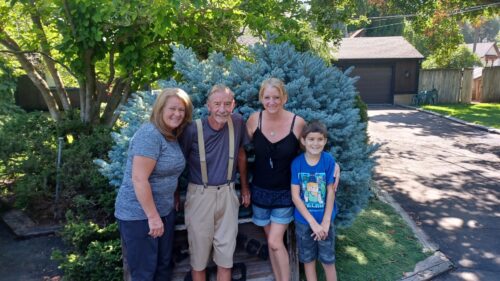
Ruth, my dad, Daniel and I at my childhood home on Hollow Road in Nibley, Utah.
When we finally met Ruth in person, it was hard not to fall in love with her. Her extremely caring and kind nature was truly genuine. I was thankful that she loved my dad for who he was. She and Daniel made an instant connection and as we got invited to various family events and scout activities, we did our best to return our appreciation for all that she made an effort to create. During our first trip, it was her wish for us to meet her mother who was turning 90. We and another one of my dad’s very good friends who had become our adopted brother, Charles, also attended. Charles use to be a very devout man of faith and worked with my dad at the university. However, after years of having coffee with my dad, he eventually lost interest in the religion and soon ended up drinking pots of coffee as if he was making up for lost time. My dad always had a way of broadening peoples perspective. Charles, my dad, Aaron, Daniel and I took a seat in a corner of the room. From there, a prayer was given. Neither of us closed our eyes and sat watching others. Afterwards, it was then encouraged that members of the family ask Ruth’s mom what it was like for her growing up. She shared all sorts of stories about her childhood and the church. Then the tone shifted. She began to share her own testimony of how the church had impacted her life. At the end, she then looked at me and my family and said that she welcomed “people like us” as she said word for word into their family. Although well intentioned, we all could feel that ‘us and them‘ dynamic that had greatly been a part of our life for so long.
The following dinner was filled with lots of food. As expected, not every family member was welcoming towards me. I could feel the coldness and at times piercing eyes. Truth be told, I probably was no better in returning a distant stance. We all were guarded and cautious. In trying to make sense of this union, we engaged in small talk and sought out the spaces that were more welcoming. One of Ruth’s daughters, Monica, provided some breathing room. She and her brother Kyle, were more of the black sheep of the family. Both were accepting and talked with us about all sorts of things and were genuinely interested in getting to know us. I could see that Monica appreciated my dad in a way that we adored her mother. In finding common ground, it always felt good to see her when we would come to visit.
The marriage brought up a lot of me and my family. In so many ways, I felt like I had moved on and healed from the things that I had endured growing up. However, a myriad of other things began to surface. I wonder how it would change my relationship with my dad, as he was that one person I felt like I could be real with given all that I had endure and navigate in my life. I worried I would lose that space.
“Do you ever tell Ruth what it was like for us when we were growing up,” I asked my dad during one phone call.
“Yes. I have told her what it was like for you and Bec. She can’t believe that people would treat you like that. Christ… I asked her if she sees a pecking order in the church and if it is there, why wouldn’t apply to people who are not Mormon. She just can’t see it. She believes that it didn’t happen given that this is not what the church teaches.”
Frustrated, I replied, “how is this possible to completely ignore what you saw with us? Doesn’t she take your word seriously?”
“You have to remember what Mormons are taught. Not everyone wants to see beyond the world that they were raised in and many follow what they are blindly taught. Ruth is a good person and truly believes in the church and its teachings. She has a big heart and I think she cannot see how others would hurt others because it is not in her nature. You have to understand that her day is full of helping others. She leaves my house at 6 AM and I don’t see her again until 8 PM at night. It is what she knows and it is also what has been expected of her. That being said, I would love it if you could share your experience with her in person some time.”
That time did come. During one of the visits, I joined them both in the breezeway of my childhood home. As my dad lit a cigarette, he then turned to me and said tell her what your life was like growing up here. I cautiously paused and then asked him ‘what’ he specifically would like me to share. He then prompted me to tell her about the church camp. Carefully, I set the scene and told her the story, knowing full well she knew each of the girls that were involved and their families. When I got to the end of my story, she was very upset and crying. The same bottled response of “I am so sorry that this happened to you and we don’t teach this,” came pouring out of her mouth. What was different though was that her anger and disgust then turned to focusing on the mothers of the girls who had hurt me. She wanted the girl’s names so she could call them and tell them what had happened. My heart softened. He disgust and fury had a least prompted something else I did not encounter. There was a genuine care and interest in desiring to take action and true things up. Instead of being passive, she looked at what she could do to try and prevent this from happening in the future for kids like me growing up there.
From there, we had an amazing conversation that was filled with connection and care. Her curiosity led to us talking about things that I had never been able to discuss when situations like this would happen. We began bridging an understanding of our worlds. As my dad sat there and occasionally would chime in to throw his two cents in, we each helped one another broaden our awareness of ourselves and each other.
Every Sunday, with the exception of church conferences, sickness or when we come to visit, my dad accompanies Ruth to church. It is a big deal. What most do not know is that it as agreement both made given that she hates his smoking. As a compromise, he accompanies her to church in exchange for putting up with his habit. Deep down, I cannot help but imagine him being some sort a metaphorical equivalent of the great white whale in Moby Dick. My dad has been vocal about his position and thoughts about the church for years, I can only speculate what stories are shared given that he shows up nearly every Sunday and what kind of gold stars Ruth has gained for such a feat.
———
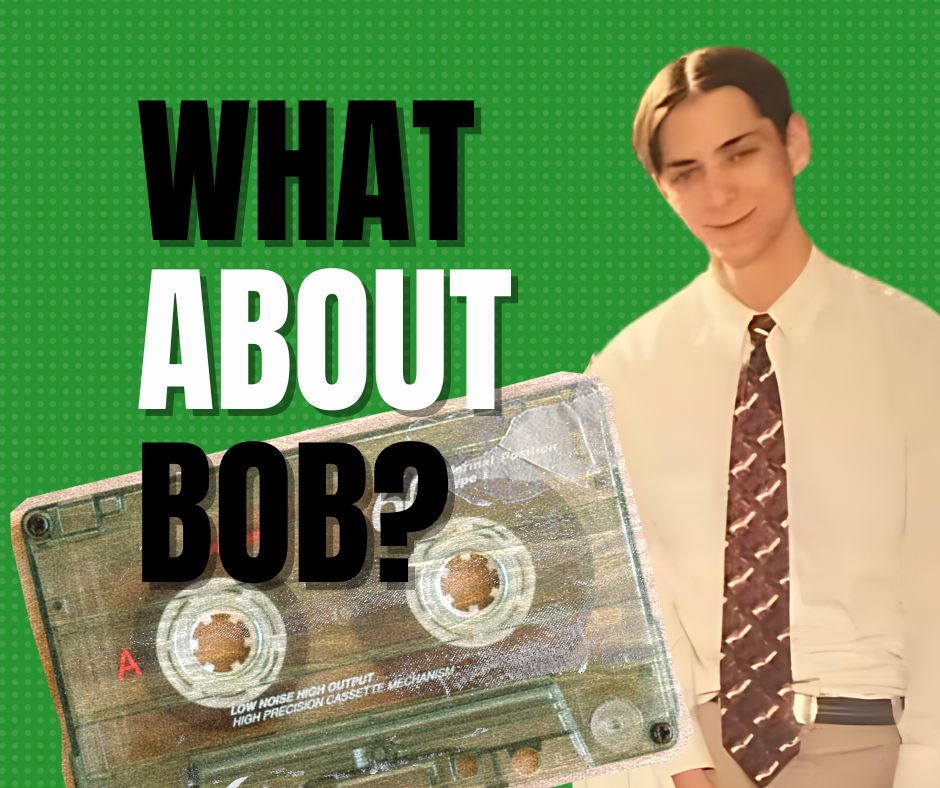 On April 13, 2024, my friend Dave reached out to me to let me know that Bob took his life. The news of his tragic passing was not shocking to me. Over the years I went home, I tried to meet with him. He had pulled away and was suffering from physical and mental issues. The pandemic took a toll on him and I could see how the pain of it all just became unbearable. This was the first time I had talked to Dave in years. I learned that Doug and Micah had attended his funeral. Dave wanted to see if I had Brion’s contact information so we could let him know. I had not talked to Brion in years and thought it would be best to reach out to him in the morning. When I woke, I was shocked to see a text message from him inquiring about an entirely different matter. I then shared the news. He asked if I could get everyone’s phone numbers. One by one, I rounded them up and sent over the information. A few days later, we started a group chat. What was expected to last a couple of weeks turned into months. Not only did we catch up on where we were at, what our families looked like and what we were doing, but we traveled down memory lane by sharing countless stories of times past. For me, it was a visceral experience. So many things I had forgotten or stowed away came pouring out. Each morning I would make an effort to get things rolling in what I affectionally called, “guy chat,” and get the conversation moving in all directions. The long string of texts and memes would pour in throughout the day that would often be result in commentary and laughter.
Bob’s passing brought up a lot of things for us all. The most troublesome, which is still an issue to this day, is that his grave does not have a tombstone. Doug shared a picture of a laminated paper that hung suspended from a wire that was driven into the ground. We all wondered why this was the case. As we speculated, each of us expressed how we wished we would have done more to be better friends and support him with the challenges he faced.
I learned that Bob suffered from many compounding physical and mental conditions at the time of his death. These physical issues arose long after I had moved away from Utah and compounded with the depression and OCD we remembered him having. He went on his mission to North Carolina, but left early due to migraines, something I also recall him experiencing often. In piecing together what we remembered and knew about our friend, we were left with the haunting image that he perished alone without the kind of love and support we all had wished he had —- the kind of support we wish we could have given. Together, we mourned. As the stories, sadness, anger and frustration flowed into the space, it naturally brought with it the other deeper wounds that we each held and carried.
Bob’s death served as a catalyst. It ignited long conversations that lasted for days. Here, we would talk candidly about the conditions and pressures that we each were subjected to while growing up that played a role in mental health and overall well-being. We talked about many we knew who struggled with addiction and were unable to cope with life. We shared openly what happened in our own families and eventually, about ourselves.
Dave was in the process of studying to become a psychiatric nurse. In reconnecting with him, he shared that in 2008, he had his first psychotic break. The experience forever changed him and as a result, he elected to leave the LDS church.
“I left because I felt love and could not judge,” he shared. “Contrasted to my experiences with the church, what was taught there and then demonstrated through action felt antiquated.”
He spoke highly of a Muslim family he met during that pivotal year in 2008 through the International Rescue Committee. He had become very close with the parents and four children they had. In 2018, this loving family opened their home to let Dave stay with them when he went fully psychotic and when Dave’s own family could not be there for him. Terrified, his friends and their children huddled in the same room together, but did not leave or abandon Dave as he worked through the episode. During this event, they generously gave him a rug and a Qur’an that were hard to obtain. During that same year, he converted to Islam. Dave’s personal experience and accounts of what he saw in the mental health field both personally and professionally added great depth to our conversation.
Doug and Micah had also completed their missions, yet unlike Dave, both remained active members in the church. They too, had stories to contribute that made each of us contemplate how the social fabric of the Utah culture had an affect on one’s overall well-being. Micah shared his experience of going to Germany on his mission. Nothing prepared him for what he experienced there. From drug use on the streets, nudity, porn, sex and the wild nightlife of music, his insulated world was shattered in an instant. While on his mission, he encountered the disdain the outside world had towards Mormons. People would spit and swear at him. Although he had done nothing to personally warrant such action, it was evident that there were people who did not care for the LDS church. Doug deepened the conversation and reminded everyone of how the history of the church involved fleeing religious persecution. As they moved from state to state and settled in Utah, we all wondered how much of this left deep wounds that permeated the culture and aided in a form of self preservation that involved protecting one’s kind and not getting too close with non members.
Bob moved from Texas to Hyrum, Utah when he was 14. His mother suffered from mental health conditions and with his grandparents watching him, it was determined that more support was needed. He moved to his aunt Cindy’s house where there she, her husband and his cousins brought him into the folds of their home. When I met Bob when I was 16, I could see he struggled to engage socially. A bit awkward, he often felt out of place. I remember observing that he was treated differently, as Cindy’s children came first and Bob was at times treated like a second class citizen. My friends and I banned together on Bob’s behalf. Given that Brion, was also a transplant into the culture, he could relate to the struggles Bob went through and at times would dish out some sass to aunt Cindy, especially when it was evident that fairness was not being demonstrated. Brion always was and still is big on accountability and follow through. When things do not match up, he often has no problem pointing out the discrepancies and questioning authority. While growing up, his dad was a police officer, and by his very nature, he rebelled against authority and the status quo. As a result, it made him a wild card in our group.
Over the months to follow, the relationship we had with one another deepened. We shared birthdays, holidays, anniversaries and other special events together along with the trials and tribulations of life in general. This group became one of my lifelines during 2025 and carried me through some really big challenges personally and with my family as I worked to step outside of my comfort zone and people pleasing behavior that I had been conditioned to perform in and under. As I worked through things real time, they became my sounding board and with it, they held me as I worked to let go of a lot of hurt I had been holding onto for years. Just as you are hearing these stories for the first time, they too listened to what I am sharing and did their best to be present and support me. We all agreed that there was a reason that we all had come back together again and that even though we could not be there for Bob when he needed friends the most, that we had the chance now to be the best friends we could be for one another. Out of love, care and regard for him and one another, we decided to act in such faith and also work together to see about getting a tombstone for Bob as an act of letting him know that he was not forgotten and will always be loved.
As I write this, I cannot help but feel the deep sadness and grief surface again. I have reflected on his passing for over a year. The deep layers of all the things that contributed to his deteriorating health make me think back to the many people I knew and loved over the years that I loved and lost. Now although Bob’s situation is unique, there is a part of me that cannot help but wonder how much the social pressures to achieve certain milestones played a role in his deterioration. From leaving a mission early, not being able to find a wife, have a family, or work in a respected role or position, I imagine that he internalized these things. Bob was always hard on himself. In personally witnessing what happened with those I knew who fell short of the churches expectations, I watched the pressure it created. For some, it was too much.
For years Utah, also known as the “suicide belt,” has consistently had higher suicide rates than the rest of the country. Recent data shows that there is a 50% – 70% higher rate than the national average. In walking as much as the middle ground as I could, I saw how polarizing both sides of the mainstream and counter culture were and still are. The blatant and subtle cues to conform are woven into every exchange, whether one is conscious of it or not. In saying that, this has been a very challenging and difficult thing to talk about, as it is not always obvious. Even now, I realize that by keeping my silence to make things easier, I enabled the culture to perpetuate the very things that harmed me and took the lives of those who I loved.
The months of exchanges in guy chat eventually brought us back together in person. It started first with a reunion with Brion. We ventured to Washington to visit him and his beautiful wife, Sarah. We had not seen them in years. As we reconnected in person and shared pictures with the group, we ignited a lively discussion of everyone wanting to gather again. Brion, who was adamantly against returning to Utah due to the traumatic experience he endured began to soften and become more open to the idea of going. Later that winter, he and Sarah went on a cross-state snowboarding trip and stopped in Utah. There, they met up with Doug, Micah and Dave along with their wonderful spouses. I made a virtual appearance for 8 or so minutes and during that time we lit up seeing each others faces. Soon after plans commenced where we would all gather and work to gather for Bob’s tombstone placement in June, 2025.
————
Given all that had been happening at home, a big part of me longed to have a trip where I could be my authentic self and laugh doing what I loved and wanted to do. So much of 2023 and 2024 had been spent in turmoil working to hold things together while also shattering my people pleasing patterns. In facing the deep wounds of my childhood and the residue of how they impacted my adult life, I desired to have a trip where I could see my friends and not feel obligated to do or participate in things that were expected of me to engage in. I knew it was going to be challenging, as it has been two years since I had seen my parents, sister and nephew.
Brion was my muse. In all the months on guy chat, he and I would test the waters with our thoughts, unsolicited opinions, and creative ideas. From developing our own Mormon lingerie underwear line called Sacred Garments, pretending my mom was running a gentleman’s club out of her house in Providence, Utah, and sending questionable pictures and memes and calling out LDS norms and contradictions, we managed to get laughs or complete silence. Out of this I decided to create special shirts for him, Shelley and myself to wear that said, “I was bullied by Mormons.” At the time, I did not know exactly how provoking this would be, but what initially started out as a gag gift, eventually evolved into something much more profound.
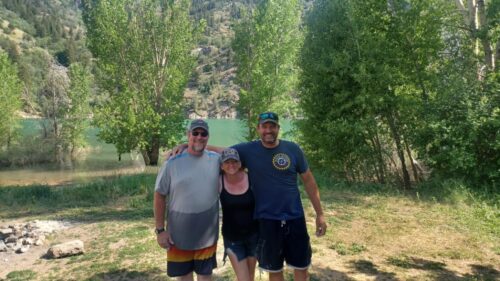
Doug, Brion and I head back to Porcupine Dam, a favorite place we loved to camp with Bob.
Brion booked a one way ticket to Salt Lake City. There he would meet Dave and join us at my mom’s house where Aaron, Daniel and I were staying with our travel trailer. My mom, sister and nephew had no idea that he was coming. A week into our visit, Brion and Dave met me at the infamous local Logan restaurant, Angies, where all of my family’s milestone celebrations happened throughout my childhood. There we sat face to face. As we ate lunch, I could not help but feel the nostalgia of days since passed returning. I couldn’t wait to go to the canyons and visit places we all use to hang out at. Here I was, 48 years old and feeling like I was when I was 17. The only person who was missing was Bob.
Prior to Brion’s arrival, my mom asked about what my plans were. I shared that I planned to meet up with Dave, Micah and Doug to honor Bob. I shared that I wished Brion would be able to meet us, but that he had to work. A smile came across her face and and proceeded to share a memory about him.
“You know what I remember about Brion,” she inquired.
“What is that,” I asked.
“I remember sitting in my rocking chair and I looked up and down the hall into the kitchen. He was there standing in front of the pantry and do you know what he did?”
“What?”
“He lifted up his shirt and licked the tip of his finger and then touched his nipple!”
I burst into laughter and knew that was something he totally would do.
When we made it back to my mom’s house, we quietly entered. Aaron and Daniel knew that Brion would be surprising my family. My mom and sister knew that I had gone to lunch to catch up with Dave. As we got settled, Brion kept quiet and we chatted with Dave. My mom was the first to come into the living room. She greeted everyone and introduced herself. In shakings hand with Dave, she then reached out to shake hand with Brion. Not recognizing him, we urged him to recreate that infamous moment in the kitchen she recalled by that he adamantly stated he did not do. Reluctantly, he did so and it was within moments she lit up with joy, yelled his name loudly and then gave him a big hug. From that point forward, the trip was filled with laughter.
Dave ended up spending the night due to the incredible connection and conversation he had with us all, especially Aaron. Waking up in the morning, it was like in high school where my friends gathered, hung out, ate and enjoyed the special space both my parents had a knack for creating. I savored every moment. As we visited the canyons, and went on adventures to places we had never gone to, we made unforgettable memories. There was something so special being in person that made everything feel electric. For the first time ever, I was in Utah being myself and felt like I had the room to breathe, be seen and loved all at the same time. It was all I had ever longed for and I so wished I had the courage to experience it sooner.
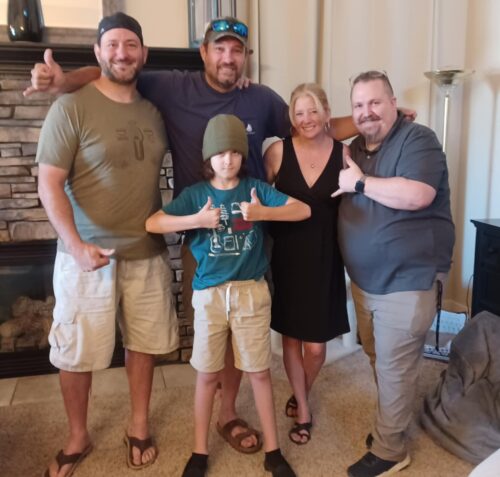
Dave joins in on the adventures!
We ventured down to Salt Lake City to see Shelley and her family. Her family kindly gifted us two rooms at Little America for two nights. During that time, we made plans to meet with Micah. It has been years since I had seen Micah and when he arrived at the hotel, I immediately recognized him. We had a brief window to talk before we met to go to Dave’s for dinner. It was here, that Micah opened up and told Brion how hurt he was by something he had said when Brion left to return to Portland after graduating high school. Welling up with emotion, Micah shared that he remembered Brion lashing out at him and calling him stupid for being Mormon. This unexpected response created a vacuum. Micah’s typical carefree demeanor fell away revealing a raw edge.
In that split moment before another word was inserted into the space, my mind instantly returned to a previous discussion where Brion confessed his sadness for not being able to be there for us. Upon learning about Bob’s death, it made him think about where he was at when he left Utah.
“I was so angry about my parents dragging us there. I couldn’t wait to get out and I know I pushed you and everyone away because I didn’t want to have an attachment to there. I didn’t want to have any associations to that horrible place.”
As he continued, he expressed his guilt. Together, we processed what was coming up. In seeing him and understanding exactly what he was talking about, I did the best I could to be present to what was surfacing.
“I feel bad as I missed out having precious time with you, Bob and our friends because of my anger…”
As Brion sat directly across from Micah, I stepped back to watch. When Micah paused, Brion stepped in and apologized. He did his best to own his actions while also acknowledging where he was at and who he was then. Micah affirmed that it was because of the space we all had intentionally created that he felt it was important to share this with Brion. Afterwards, the remaining time we had together was deeply meaningful. None of us wanted to say goodbye.
Before we left Utah, Brion and I decided to wear our Bullied by Mormon shirts and venture out into the public spaces to see what kind of reactions we could elicit. When we shared our shirts with they guys, Doug immediately laughed and said he needed one, as he too had been bullied by Mormons. His response was like salve. It delivered that honest and most genuine form of seeing things for as they truly are, not what one wanted them to be. Little did Doug know, he gave me one of the greatest gifts of a lifetime I could have ever hoped for. His response made me feel deeply seen and in delivering it with the honesty that we both shared common ground, I felt safe to be myself. In that moment, we stepped outside the social fabric we had both been conditioned to adhere to and entered into a space that felt real, raw and freeing. It is an experience I will never forget.
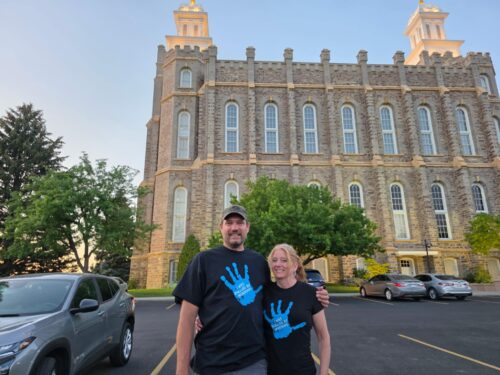
Brion and I at the LDS Logan Temple.
As an intention experiment, we put on our shirts and headed out to a local pub. No one really noticed what creative genius was at play. So, we then ventured to the Logan Temple. Standing in front of the temple on such sacred grounds, we laughed and smiled for having the courage and audacity to be so bold to be the “heathens and sinners” we had been labeled as though out our time there. With only a few puzzled glances, we decided to try a different approach.
The next day, we decided to go to Macy’s. Our plan was to have Brion wear his shirt and see what kind of reactions he could generate. As we parked and made our way toward the entrance of the store, immediately, men began to scowl at him. I watched reactions and as we went through the store, and of course bought a six pack, we noticed that men and some women gave some unfavorable glances towards him. Later, I returned wearing my shirt. Brion and Aaron followed me. No one appeared to notice. It was like I was invisible. Stunned, I requested to go to another store. The same thing happened…
What had been intended to generate some sort of reaction was met with silence and worse yet, invisibility. What I discovered and learned from this experience was steeped in a core wound that affected my whole reality and shaped my identity for most of my life. In anticipating how to respond to one question, “are you LDS,” my answer would dictate how I would be treated, received or discarded. Regardless, the chances of me ever being seen for who I was beyond my response what greatly limited. It reinforced it was not safe to be seen and if I was, that I could only exist in certain spaces. I could only show parts of myself that were favorable and desired. It was unsafe to be whole. It was dangerous to be authentic as it would not only put myself in harm, but those I loved.
On the contrary, I have learned to imagine what this question queued for those who were of the Mormon faith. What did they have to hide, accentuate or contort to? How did they have to adapt their actions, words and choices to those who were watching, constantly in ways both seen and unseen? What did they have have to let go of in order to belong?
To be loved partially is a tragedy.
I was bullied by Mormons. So were my friends. In all honestly, everyone I have ever met has been bullied and if there is one thing that this experience has taught me, is that the only consciousness we have every known is that of oppression. Just as it divides, it also unites. In recognizing that this is the the consciousness and common ground that unites us all, we have an opportunity to transcend it, and in doing so we must be willing to have the courage to seek and dream away out of what we know and be open to the possibility of what could be. What you seek will find you and it is my hope that by sharing these stories that you and I can find the courage to see what it takes to transcend such consciousness to create something greater and more whole for us all.
If we ever wish to be fully seen for who we are, we must be willing to challenge and risk what and who we are told to be. It in entering a space where truth can heal, we make room for who we wholly are and could be. To live a life based on what others think we should or should not do robs us of the chance of discovering what makes us come alive. It deprives us from chances of meeting people who could significantly alter our life for the better. If we only stick to what we know, we will never know the greatness of what is possible.
Religious oppression is one of the many tendrils that make up the world that humanity encounters. The truth is, there are countless more. When you pause and begin to feel into the consciousness we are steeped in, you can sense the subtle and overt currents that are like water that make up the very reality that we know and live in. The constructs, beliefs, ideals along with the masks and identities that we slip in and out are all shaped and influenced by oppression. In writing about this, my hope is that by sharing my stories that I will ignite a spark of curiosity to wonder what life would look like if we could experience ourselves and the world around us beyond the scaffolding of oppression. Who would we be? What connection would we discover? What would we create? Would we find a deeper truth that in turn liberates and heals our being and thus enables us to experience reality through a new lens we have never looked through? These are the questions that I am filled with and my hope is that by releasing these stories from my vault that I will find other fellow adventurers to join me in finding out what could, can and will be by pursuing something better than we can even imagine. Together, may we experience greater that restores one’s spirit versus confines and fractures it.
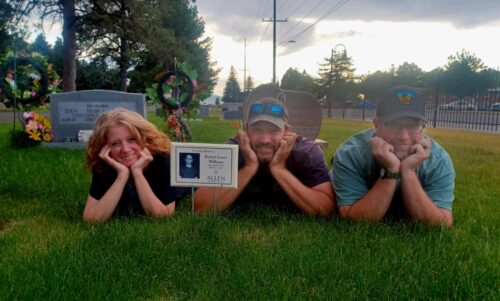
Brion, Doug and I at Bob’s grave in the Logan Cemetery.